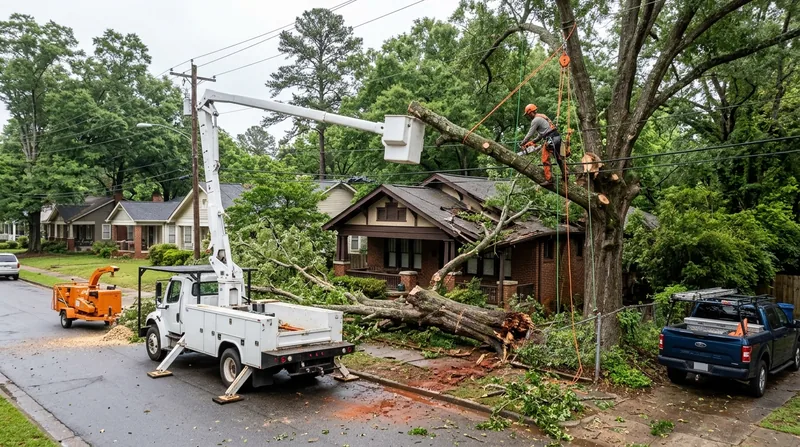




Columbus sits on the Fall Line where Piedmont hills meet the Coastal Plain, and that geography means trouble for trees. The older neighborhoods of the Historic District, Wynnton, and Lakebottom are shaded by massive water oaks, laurel oaks, and loblolly pines that have stood for 80 to 120 years. When spring thunderstorms roll through, when late-summer tropical remnants bring sustained wind, or when ice storms load branches with weight they cannot hold, those old giants fail fast. A emergency tree service in Columbus that answers at 2 a.m. on a Saturday is not a luxury; it is the difference between a controlled removal and a crushed roof, a severed power line, or a neighbor's fence destroyed. We dispatch crews within hours to fallen, leaning, or split trees threatening your home or property, and we handle full cleanup so you are not left managing debris and hazard yourself.
Why Emergency Tree Removal Matters in Columbus: The Real Risk
Columbus homeowners face a specific and serious tree risk tied to the city's climate and aging tree stock. The combination of hot, humid summers, sudden spring thunderstorms, and occasional tropical-storm-remnant winds creates a perfect storm for limb failure. Water oaks and laurel oaks, which dominate the shaded lots of the Historic District and older residential areas, are prone to heart rot and sudden limb drop, especially in drought years. When a 40-pound limb or a 60-foot section of trunk fails without warning, it does not wait for business hours or a scheduled appointment.
- A fallen oak or pine across a roof or power line requires immediate professional removal to prevent further damage and restore safety.
- Trees leaning toward a house after a storm need rapid assessment and removal before the next wind event knocks them over completely.
- Split or partially uprooted trees create ongoing hazard and cannot be left standing while you wait for a Monday estimate.
- Limbs hanging over gutters, decks, or driveways pose injury risk and must be cleared before someone is hurt.
Quick response and safe, professional removal are the only way to protect your family and property when a tree fails.
Key fact: Heart rot in water and laurel oaks can make limbs fail with no visible warning. A tree that looked fine in July can drop a major limb in August after a dry spell. This is why we offer 24/7 emergency response, seven days a week.
For more detail on how we handle standard removals, see our tree removal service page. For permit requirements in your area, check with the City of Columbus Planning and Zoning Department or visit columbusga.gov for local tree ordinance details.
How We Handle Emergency Tree Service in Columbus: Fast, Safe, Complete
When you call us after a storm or when you spot a dangerous tree, we do not send an estimate appointment three days out. We dispatch a crew to assess the hazard, remove the tree safely, and haul away debris the same day or the next morning, depending on the time of your call and crew availability. Our process is built for speed without cutting corners on safety or cleanup.
- Call us at (706) 786-4955 with photos or a description of the tree and the hazard it poses.
- We ask you to stay clear of the tree and advise you on immediate safety steps, such as turning off the deck or staying inside if the tree is near the house.
- A crew arrives within hours to assess the tree, the surrounding property, power lines, fences, and structures, and to plan the safest removal sequence.
- We use climbing, rigging, and crane removal as needed to bring the tree down in sections, protecting your roof, fence, and landscaping.
- All debris is chipped, hauled, or stacked for removal, and the area is cleared so you can see the ground again.
From the moment you call to the moment the last chip truck leaves, we own the entire job and the cleanup.
Real example: A 60-foot water oak in Wynnton split down the middle after a Saturday afternoon thunderstorm, with one half leaning hard against the house and the other half threatening the power lines. We arrived within two hours, rigged the lean-to section to drop it safely into the yard, then sectioned and removed the rest. Debris was cleared by evening. The homeowner was able to get a roofer out Monday morning to assess the impact.
If you need ongoing tree trimming and pruning to reduce the risk of future failures, we can discuss that after the emergency is resolved.
Emergency Removal Methods: Which Approach Works Best
Not every emergency tree removal looks the same. A small oak that fell across a fence is handled differently from a massive pine that took down power lines or a tree split in half with sections hanging over the roof. We choose our method based on the tree size, the hazard, the proximity to structures, and what we can safely access.
| Approach | Description | Best for |
|---|---|---|
| Climbing and rigging | Arborists climb the tree and lower sections using ropes and pulleys to control the fall and protect surrounding property. | Trees close to houses, fences, or power lines where precision and protection are critical. |
| Crane removal | A mobile crane lifts large sections or the entire tree out in one or two pieces, minimizing ground impact and debris scatter. | Large trees in yards with good access, or when time is critical and a crane can be positioned safely. |
| Sectional felling | The tree is cut into manageable pieces from the ground or from a bucket truck, with each section controlled as it drops. | Trees in open yards with room for debris, or when climbing is not practical due to tree condition or hazard. |
| Bucket truck work | Our operators work from an elevated platform to cut limbs and sections, lowering them to the ground with ropes or letting them fall safely. | Hazard limbs, split trees, or situations where the tree is too unstable or damaged to climb. |
We assess the tree on arrival and choose the method that gets the hazard removed fastest while keeping your property and our crew safe.
Emergency Tree Service Cost in Columbus: What to Expect
Emergency tree removal pricing in Columbus depends on several concrete factors: the size and species of the tree, how close it is to your house or power lines, whether it has already fallen or is still standing but hazardous, and how much debris needs to be hauled. A 40-foot oak that fell across a fence in a wide-open yard costs far less than a 70-foot pine split against the side of a house in a tight lot. We start every emergency call with a free assessment and a realistic estimate based on what we see.
Most emergency removals in the Columbus area fall between $1,200 and $4,500, depending on complexity and tree size. A smaller tree or a straightforward fallen limb may run $800 to $1,500. A large, hazardous tree close to structures, or one requiring crane work, can reach $5,000 to $8,000 or more. The best way to understand your cost is to call us with photos and a description, or to have us come out for a free on-site look.
Do not wait to get pricing until after the storm. If you have trees you know are risky, call now for a free estimate and consultation so you know what removal would cost before an emergency forces your hand. We can also discuss our full pricing and service options for planning purposes.
What to Look for When Hiring Emergency Tree Service Near Me in Columbus
When a tree is down and you need it gone now, you may be tempted to hire the first crew that answers the phone. Resist that urge. A few key checks protect your property, your liability, and your wallet. Verify that the company is fully insured, check references from recent emergency jobs in Columbus or nearby towns, and confirm they understand local tree removal permits and heritage tree ordinances. If your home is in an HOA community, check whether visible removals require approval before work begins.
Fully insured means the crew carries general liability insurance and workers compensation, so if something goes wrong, you are not liable for injuries or property damage. Ask to see a certificate of insurance before work starts. Get a written estimate that breaks down the removal cost, debris removal, and any travel or equipment fees. If the tree is a protected species or is over a certain diameter in your neighborhood, a permit may be required; a professional crew will know this and factor it in. If you are unsure, the City of Columbus Planning Department can answer questions about local tree ordinances.
Finally, check references. Call two or three recent customers and ask how the crew responded, how clean the cleanup was, and whether the final bill matched the estimate. A reliable emergency service will have references ready and will not hesitate to provide them. When you are ready to book, contact us with details of your situation so we can give you a realistic timeline and cost.
Emergency Tree Service in Columbus: Pricing Guide
| Service | Price | Details |
|---|---|---|
| Free emergency assessment | Free | We evaluate the hazard, discuss removal options, and provide a written estimate within 24 hours of your call |
| Small emergency removal | Starting at $800 | Fallen limbs, small trees, or straightforward removals in open yards with easy access and minimal debris |
| Standard emergency removal | Starting at $1,500 | Mid-size trees, trees near structures or power lines, or jobs requiring rigging or bucket truck work and full cleanup |
| Complex or large-scale removal | On estimate | Trees over 60 feet, crane work, multiple hazards, or removals in tight lots require on-site assessment before pricing |
| Travel and dispatch | Included | No separate mileage fee for emergency calls in Columbus and surrounding service areas within reasonable response zone |
| 24/7 emergency response | Free | Estimate and dispatch consultation available any time, day or night, at (706) 786-4955 with no obligation to book |
Indicative pricing, the exact cost depends on square footage, finish, and site access. Free personalized estimate within 24h at (706) 786-4955.


